Showing posts with label theme and variations. Show all posts

Monday, March 28, 2011

Elgar: Enigma Variations, Op. 36 - Variations X-XIV


X. Dorabella - intermezzo: allegretto
dora penny was a great friend who also had a stutter, depicted in the wind interjections in every bar. the first note of these little interjections is almost always stressed, giving a bit of an off-kilter feeling. the nickname was taken from mozart's cosi fan tutte. apparently elgar had a flirtatious but mild relationship with her, and this light and lovely variation reflects that. i particularly like the cello solo.

XI. G.R.S. - allegro di molto
ok it is actually all i can do to actually post this video because the images are kind of gross, please don't actually watch the video when you listen =/
george robertson sinclair was an organist at a cathedral. he owned a big bulldog called dan, and the variation has almost nothing to do with sinclair except that the dog was his. the first rapid descent shows the dog tumbling into a river. he struggles by swimming upstream, and finally manages to scramble to the bank, barking triumphantly.
sorry for the gross video...

XII. B.G.N - andante
basil g. nevinson was a well-known cellist, hence the big cello solo interlude that bookends this variation and the predominantly cello section melody. nevinson was the inspiration for the cello concerto, which elgar completed some years later.

XIII. *** - romanza: moderato
this is my favorite variation because of the transformative middle section. wiki reports that this was supposed to be lady mary lygon, a friend of elgar and his wife who just happened not to be available when the variations were finished and elgar sent her a note requesting to use her initials. but a different story gaining traction is that the stars actually refer to a secret lover that elgar had named dora adeline nelson, and they had a love child named pearl. nelson was a cook in the kitchens; being of lower caste, elgar could, of course, never acknowledge their existence or his love, but apparently it was an open secret in the servants' circles. who knows? but it would certainly be more of a reason to keep the stars - it somehow seems unlikely that lady mary lygon would have refused to let her name be used even post publication, and if it were innocuous it seems elgar had plenty of time afterwards to clarify it. buuuut, there are at least two other theories out there, including "helen weaver" and "alice stuart-wortley."
anyway, the variation's main material is graceful and lyrical and suggests a lady for sure. but the middle section i mentioned is introduced by a sudden cessation in the flowing movement of the theme, and seems really to have nothing to do at all with the theme. alternating thirds in the violas underly a timpani roll played with hard sticks, giving a metal edge to the sound, kind of an ominous rumbling on the horizon. the clarinet solo is apparently a quotation from mendelssohn's calm sea prosperous voyage. this is all in the harmonically far away key of a-flat major.
you get some bernstein for the last variation because the other guy is too noob to finish his collection of videos. (i would have uploaded all bernstein, but for some reason this is the only movement that was posted.)

XIV. E.D.U. - finale: allegro presto
edu was his wife's nickname for himself. the finale is longest besides perhaps nimrod, and includes throwbacks to the variations of the two biggest influences on his life, II (his wife) and IX (nimrod/jaeger). we end triumphantly in g major.

Elgar: Enigma Variations, Op. 36 - Variations V-VIII

V. R.P.A. - moderato
richard penrose arnold was also an amateur pianist and the son of a poet. elgar wrote that his playing had a way of "evading difficulties but suggesting in a mysterious way the real feeling. his serious conversation was continually broken up by whimsical and witty remarks."
this actually makes complete sense if you listen to the movement, which suggests a darkness that could easily be soupy and anguished but moves a bit too easily for that. then of course the major section brings in the "whimsical" insertions by winds and violins.

VI. Ysobel - andantino
the variation is attacca from the previous, and begins right at 2:19. isabel fitton was a viola student of elgar's. the variation is played mostly by a solo viola, and the opening viola (section) statement includes a sort of exercise in string crossing, reportedly one of elgar's jokes, in which the viola has to cross from the C string to the D string without hitting the G string in between (the interval is a tenth - from the open C to an E above that). so i can imagine that for a performer/conductor aware of this, it would be important to resist the temptation to use a less awkward fingering of just putting the E up on the G string in third position.
the moment when the strings melt away to reveal the solo viola is particularly lovely.


VII. Troyte - presto
arthur troyte griffiths was an architect and amateur pianist who was apparently quite terrible at playing the piano. this apparently represents elgar's abortive attempt to teach him, and his "enthusiastic incompetence." wiki, though, reports that the almost unplayably fast movement depicts a day when they both got caught in the rain and had to make a mad dash for shelter. i like to think that elgar wrote those ridiculous fifths in hopes that violinists wouldn't be able to play it that fast and it would more effectively represent troyte's fail on the piano.
(i find the images that accompany this movement in the above recording hilarious.)

VIII. W.N. - allegretto
winifred norbury was a friend of elgar's who was fairly easygoing, but most accounts agree that the variation is as much about the house she lived in as the woman herself. the house itself was a classic 18th century house which was the site of many chamber performances and musical gatherings. one writer suggests that her laugh is hinted at in the central section (the oboe + trills).


IX. Nimrod - Adagio
this is far and away the most celebrated of the entire set of variations, and gets played often independently. it's slow and chorale like, and depicts an episode in elgar's life in which his friend augustus jaeger convinced him to continue composing even after elgar had decided to stop. nimrod, the "mighty hunter" in the Book of Genesis, is a reference to the german meaning of jaeger's name, hunter. jaeger provided support and constructive criticism throughout elgar's composing career, and was his closest musical friend.
the opening bars carry a small hint of beethoven's work (according to elgar himself, it is just a shadow of the opening of the second movement of beethoven's pathetique sonata). this was, apparently, what jaeger himself hummed when he reminded elgar that beethoven had had to go through great difficulties but continued to compose greater and greater music. 

Elgar: Enigma Variations, Op. 36 - Theme, Variations I-IV

there are 14 variations (plus a theme) in all. here they will be divided up into 3 entries. the whole thing totals just over 30 minutes, about the length of a very short symphony, so i don't feel too badly about trying to use this to catch up to my intended post rate :P

this is elgar's one and maybe only well-known orchestral work, excepting maybe his cello concerto and to a much lesser degree his second symphony and violin concerto. elgar was an english composer from 1857-1934, and he wrote this piece in 1899, in his forties.

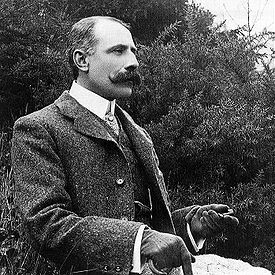
check out this epic handlebar mustache.


elgar considered himself a sort of outsider in the british music scene and we know he was heavily influenced by the music of continental europe. but, when we (performer musicians) think of elgar we can't help but think of quintessentially english music. probably like this image, his british identity has probably become bound with his compositional qualities in your mind already.

but lets put this aside for now.
nobody who has ever heard of this piece doesn't know that these initials refer to people who were important to elgar, and until recently we didn't even know about half of them. so now that we do know them (or so we think), it's of course one of the favorite guilty pleasures of program-music analysts/lovers to find which aspects of the personalities are reflected in the music.


Theme

usually themes require little explanation, but this is one of the most complex themes i have ever heard. not that it's really that harmonically or structurally complex, but the one quality of most themes i've heard is that it is memorable - an earworm, even - and singable. this is neither. it definitely took two or three play-throughs for me to even be able to hum the thing from memory, and even then it's not always clear what the "melody" of the theme is. so listen to the beginning a few times. of course, it's likely that you've hear this piece a few times already and so might already know what the theme sounds like, but i had never even listened to this piece until last week.

the story goes that elgar was improvising at the piano, and his wife enjoyed hearing this particular little bit of music, upon which he decided to improvise several variations about their mutual acquaintances.

the theme is sort of mournful, even a bit solemn. we begin with a sort of fragmented, breathy, off-beat G minor. this segues directly into a middle section which is a bit more lyrical, in G Major. then the g minor material comes back, fragmented as before. the ending chord is a G Major.

before the premiere elgar said something interesting: "The ‘Enigma’ I will not explain – its ‘dark saying’ must be left unguessed, and I warn you that the apparent connection between the Variations and the Theme is often of the slightest texture; further, through and over the whole set another and larger theme ‘goes’, but is not played . . . So the principal Theme never appears, even as in some late dramas – eg Maeterlinck’s L’Intruse and Les sept Princesses – the chief character is never on stage."
these sentences have been discussed pretty much to death. but for me this explains the fragmentary nature of the theme itself. for him the theme existed somewhere else, and is never fully realized in the entire work. think of the theme as a sort of window, which is partially obscured and doesn't allow the entirety of the light behind to come through.
furthermore, contrary to what everyone thinks, the "enigma" refers to this obscured quality of the theme. NOT the initials!
i'm going to go on a small tangent. if this portrayal of the theme is right, then it definitely explains why the theme actually sounds like a variation. one can imagine a sort of pre-theme that IS singable. after a bit of experimentation i have a line that basically just follows what the bass line does.
(halfnotes to each note)
Bb C D Eb D C Bnat C C# D Eb C
B  C D E D C B A
it's interesting that in this light the major section is pretty much an exact copy, harmonically, of the minor section, with the necessary changes to make it into a major.
i think the real theme would go something like: B a g C a D c bb A c Bb c d G a F eb d C eb...
etc

I. C.A.E. - l'istesso tempo
caroline alice elgar was his wife. wiki reports that the four note motif that opens the movement in the violins (A# B F# G, I think) is something elgar used to whistle when coming home to his wife. in rehearsal the conductor told us that his wife was a gentle, very domestic person, which is reflected in all this very understated variation except the outburst of passion that comes out of nowhere and lasts for all of two bars, not even given a proper cadence before shrinking back into its shell. presumably this was a portrayal of how elgar saw her.


II. H.D.S.-P. - Allegro
hew david stuart-powell, an amateur pianist. the highly chromatic toccata-like style of this variation makes it a nightmare for the orchestra. apparently this is a big travesty of the licks he used to warm up with on the piano before beginning to play. elgar wrote that it was chromatic to beyond stuart-powell's liking. he played a lot of chamber music with elgar.

III. R.B.T - Allegretto
richard baxter townshend receives the first "major" variation. he was the author of the "tenderfoot" series and also an amateur actor, and elgar liked how his usually low voice "flew off" into the soprano range when he was acting. i suppose you can hear this in the oboe, with the swells on higher notes, and the little interjections in the strings.

IV. W.M.B. - Allegro di molto
this exuberant, galloping variation belongs to william meath baker, who was "a country squire with an abrupt manner and a tendency to bang doors behind him when leaving a room." elgar wrote that he "expressed himself somewhat energetically."

Sunday, January 16, 2011

Kreisler/Corelli: La Folia for Violin and Piano

doing the daily thing is turning out to be pretty difficult.

for saturday: an arrangement of the famous theme la folia which has been used by over 150 composers throughout history, beginning at least in the 16th century.

d: (i)-V-i-VII-III-VII-i-V-(i)
this is the basic structure, which lends itself to an infinite number of fascinating variations. because the theme itself (and the chord progression) are so interesting, this is one set of theme and variations i find quite compelling.


the milstein below is corelli's own variations on the la folia theme.


enjoy.

Friday, January 7, 2011

Brahms: String Sextet No. 1 in B-flat Major, Op. 18 - II. Andante ma moderato

chamber fridays, in honor of classical music hour on fridays at princeton (or because i felt like i needed to have a day dedicated to chamber music)

this sextet might be brahms's best work for a chamber group that doesn't include piano. the problem with a lot of his string quartets is that he basically tries to write a piano piece and then divide it among the four string parts - at least, this is what it sounds to me. so invariably some instrument ends up with an ostinato or half of a chord that isn't quite as fulfilling because it doesn't fill out the texture the way it would on a piano. even if he assigns double stops and the like to the string instruments, because of all the different voices/timbres, it still often sounds sort of thin or ungrounded.

this is a problem brahms solves in this piece by adding more instruments. it's easy to imagine that things might get bogged down quickly with six instruments - 150% the normal group - and it is indeed a very, very different experience playing with six people as opposed to four. but i think i would be hard-pressed to find moments in this sextet that are actually too thick the way they might be if other composers tried to tackle the same ensemble.
there aren't that many string sextets out there - the other famous one is, of course, tchaik's souvenir de florence, which also doesn't have *that* much trouble being heard clearly, but this is because it's basically a first violin concerto (and sometimes a cello concerto). the same goes for mendelssohn's string octet. it seems the bigger the ensemble, the more need for one, perhaps two parts to come out prominently by virtue of being higher or more melodic). there's something about the magic number four that makes the string quartet full enough to be gratifying, but still an "equal" partnership among the four players. i think this is still the sort of aesthetic brahms goes for even with six players, though, and i think this is actually much more successful than his string quartet endeavors.

ok, on to the actual piece.

this sextet was written in 1860, just after the first piano concerto (op. 15). during this time he was basically juggling jobs between hamburg and detmold. this was also at the height of his public "feud" against the school of wagner and liszt, who thought he was too old-fashioned. he would later withdraw from that argument entirely. he later earned more widespread popularity in 1868 with Ein Deutsche Requiem.

this movement is a set of theme and variations. brahms is one of the only composers whom i consistently "trust" to handle this form in a way that maintains my interest. i think this has something to do with his ability to fill in a plain theme with a unique contour and insert a moment (in this case, a couple variations) of absolute gorgeousness. with this movement, every variation taps something really visceral, and the soft/major variations are sublime.
fantastic, raw, and very powerful recording, especially the first major variation. for comparison's sake,
this version is much more demure - you can hear it in the first two seconds. it's got its own beauty in its cleanliness and grace, but for me there's no real comparison.
edit: after discovering the first video is no longer legal in the US (and actually not having any idea who it was), i have begrudgingly looked up a second recording which i also consider to be very powerful.


the movement has the following variations:
I. theme, which is so simple and tuneful and yet angsty and intense that it really keeps your interest from the get-go, something already unique in the realm of themes and variations - themes usually are so simple you can't wait to hear what the composer's going to do and can we please just get the theme over with. not so here.
II. a variation which passes the arpeggios between all the instruments while keeping the firm marching chords on top of them
III. triplet variation. he throws in some great harmonic changes just at the end of the first half - switching to F major just briefly before descending back.
IV. stormy harmonic minor scales with lots of surging swells
V. the first major variation: songful and broad and breathy. the transition into this variation is an awesome moment.
VI. a much more delicate gossamer variation - the melody, given to the first viola, becomes something gentle and flowing (it doesn't even really sound like a melody - more like the harmony part, if a more straightforward version of the melody were present). it's accompanied by open strings and falling open intervals in the violins.
VII. a reprise of the theme, except made more solemn, heavier, by giving the melody to the cello and accompanying that with heavy, rhythmic pizzicati. marches on to a quiet close that somehow morphs into major magically just before the end.
aaaaaahhhhh it's so good!!!